← codec comparison (index.html) · SPEC §3: time axis
fluxcode can store each sample's timestamp exactly next to its values (by default; the
last section lets them move by a share of an interval). This page covers only that time
axis: what the timestamps add to a one-minute block group (60 blocks of 1,000 samples, nominally 1 kHz, int64 ns ticks).
Every number here is the block group with times minus the same block group without them. For scale, that block group's values alone take
17,976 bytes (a 4.12 Hz sine at the default settings), 311 µs to encode and
100 µs to decode.
Regenerate: cd experimental && uv run python make_time_report.py.
A perfect grid, and a perfect grid with a few gaps, are by far the most common timestamps in practice. A noisy clock (host timestamps on arrival) is the third common shape, and the only one of the three where the timestamps cost more than the values (here about two and a half times as much).

| shape | what it is | bytes (example) | bits/sample | irregular blocks | vs values | bytes over 64 groups: median | max | encode time added | decode time added |
|---|---|---|---|---|---|---|---|---|---|
| Perfect grid | Every interval exactly 1 ms: hardware-clocked acquisition, resampled or synthesized series. | 66 | 0.009 | 0/60 | 0.4% | 66 | 133 | +13 µs (+4%) | +14 µs (+14%) |
| Grid with a few gaps | A perfect grid that sometimes skips: dropped packets, reconnects, a paused logger (Poisson, mean 2 gaps per minute, each 5 ms to 3 s). | 167 | 0.022 | 2/60 | 0.9% | 166 | 834 | +15 µs (+5%) | +15 µs (+15%) |
| Noisy clock | Host timestamps on arrival: 1 ms nominal, σ = 20 µs jitter, µs resolution. | 53,413 | 7.122 | 60/60 | 297.1% | 53,411 | 53,560 | +336 µs (+108%) | +119 µs (+119%) |
The example is the median-size block group of 64 seeds per shape. Times are single thread, best of 60, Apple M3 on AC power; each added time's percentage is of the same block group's values-only encode (311 µs) or decode (100 µs). vs values is the timestamps' bytes as a share of the values' 17,976.
Params(time_error=0.1) the same clock
costs 65 bytes (last section).A grid with k gaps per minute, each 5 ms to 3 s; median of 16 block groups per row.
| gaps per minute | irregular blocks | bytes | bits/sample | bytes per gap |
|---|---|---|---|---|
| 0 | 0/60 | 63 | 0.008 | — |
| 1 | 1/60 | 125 | 0.017 | 62 |
| 2 | 2/60 | 164 | 0.022 | 51 |
| 5 | 5/60 | 747 | 0.100 | 137 |
| 10 | 9/60 | 914 | 0.122 | 85 |
| 20 | 17/60 | 1,140 | 0.152 | 54 |
| 60 | 38/60 | 1,374 | 0.183 | 22 |
For comparison, shapes with many more irregular blocks (from bench/time_axis.py). Only the
cases with random intervals cost more than the values. Percentages are of the values-only encode and decode, as
above.
| timestamps | bytes | bits/sample | irregular blocks | encode time added | decode time added |
|---|---|---|---|---|---|
| 1 kHz, 20 gaps | 1,094 | 0.146 | 19/60 | +97 µs (+31%) | +60 µs (+60%) |
| 1 kHz, 1% dropped | 1,461 | 0.195 | 60/60 | +261 µs (+84%) | +123 µs (+122%) |
| drifting clock (0.99998 ms) | 339 | 0.045 | 60/60 | +216 µs (+69%) | +85 µs (+84%) |
| jitter σ=10 µs, ns resolution | 120,712 | 16.095 | 60/60 | +416 µs (+134%) | +178 µs (+178%) |
| jitter σ=10 µs, µs resolution | 45,903 | 6.120 | 60/60 | +336 µs (+108%) | +126 µs (+125%) |
| Poisson events, mean 1 ms, µs | 87,889 | 11.719 | 60/60 | +341 µs (+110%) | +160 µs (+160%) |
| Poisson events, mean 1 ms, ns | 164,661 | 21.955 | 60/60 | +379 µs (+122%) | +189 µs (+188%) |
| deadband logging, ms grid | 55,498 | 7.400 | 60/60 | +513 µs (+165%) | +219 µs (+218%) |
| bursts 10 kHz / idle | 102 | 0.014 | 60/60 | +121 µs (+39%) | +91 µs (+91%) |
1% dropped and a drifting clock stay cheap: their intervals take two or three values. Jitter, Poisson events and deadband logging have random intervals, and ns resolution costs more than µs when the jitter really is at ns resolution.
When the jitter is measurement noise, Params(time_error=e) lets fluxcode round the timestamps
(0 to 0.5; the default 0 keeps them exact). Each block gets a coarse consistent step at which 95% of its
times keep within e of their own interval, and none moves more than e of the block's mean interval.
The values are kept as measured, and the format doesn't change: the decoder sees ordinary times.
update_time_blocks stores new times exactly, and replace_time_blocks re-encodes
whole blocks from the samples given.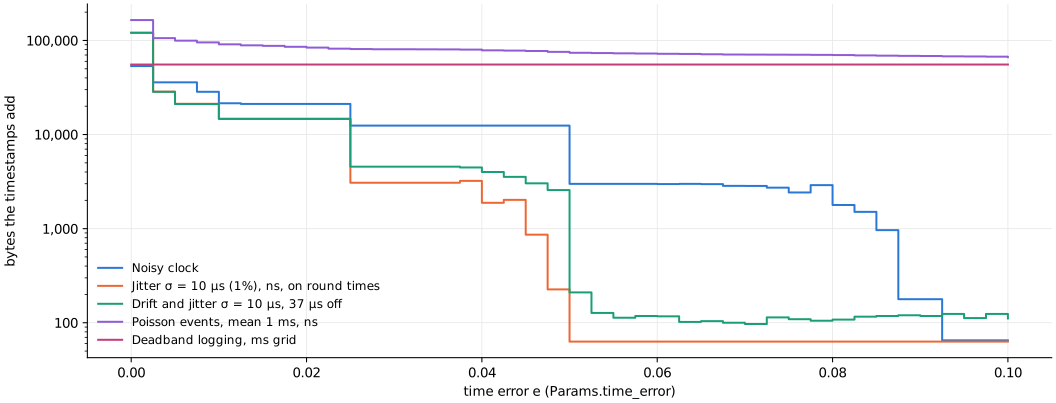
| timestamps | exact | e = 0.02 | e = 0.05 | e = 0.1 |
|---|---|---|---|---|
| Perfect grid | 66 B · 0/60 +12 µs (+4%) | 66 B · 0/60 +30 µs (+10%) · max 0.000 | 66 B · 0/60 +28 µs (+9%) · max 0.000 | 66 B · 0/60 +29 µs (+9%) · max 0.000 |
| Grid with a few gaps | 167 B · 2/60 +41 µs (+13%) | 167 B · 2/60 +53 µs (+17%) · max 0.000 | 167 B · 2/60 +42 µs (+14%) · max 0.000 | 167 B · 2/60 +42 µs (+14%) · max 0.000 |
| Noisy clock | 53,413 B · 60/60 +358 µs (+115%) | 21,168 B · 60/60 +433 µs (+139%) · max 0.010 | 2,990 B · 60/60 +435 µs (+140%) · max 0.050 | 65 B · 0/60 +86 µs (+28%) · max 0.092 |
| Jitter σ = 10 µs (1%), ns, on round times | 120,712 B · 60/60 +419 µs (+135%) | 14,726 B · 60/60 +418 µs (+134%) · max 0.010 | 63 B · 0/60 +86 µs (+28%) · max 0.046 | 63 B · 0/60 +84 µs (+27%) · max 0.046 |
| The same, free-running: 50 µs off the epoch's grid | 120,653 B · 60/60 +421 µs (+136%) | 14,667 B · 60/60 +409 µs (+131%) · max 0.010 | 66 B · 0/60 +113 µs (+36%) · max 0.044 | 66 B · 0/60 +113 µs (+36%) · max 0.054 |
| Drifting clock (0.99998 ms) | 339 B · 60/60 +214 µs (+69%) | 87 B · 0/60 +94 µs (+30%) · max 0.020 | 93 B · 0/60 +91 µs (+29%) · max 0.049 | 93 B · 0/60 +88 µs (+28%) · max 0.098 |
| Drift and jitter σ = 10 µs, 37 µs off | 120,648 B · 60/60 +409 µs (+132%) | 14,661 B · 60/60 +409 µs (+132%) · max 0.010 | 210 B · 1/60 +111 µs (+36%) · max 0.050 | 111 B · 0/60 +94 µs (+30%) · max 0.100 |
| Poisson events, mean 1 ms, ns | 164,661 B · 60/60 +384 µs (+124%) | 83,895 B · 60/60 +504 µs (+162%) · max 0.001 | 73,951 B · 60/60 +495 µs (+159%) · max 0.002 | 66,463 B · 60/60 +500 µs (+161%) · max 0.005 |
| Deadband logging, ms grid | 55,498 B · 60/60 +552 µs (+178%) | 55,498 B · 60/60 +651 µs (+209%) · max 0.000 | 55,498 B · 60/60 +648 µs (+209%) · max 0.000 | 55,498 B · 60/60 +642 µs (+207%) · max 0.000 |
| 1024 Hz clock, jitter 0.5% (no 1-2-5 step divides the period) | 112,735 B · 60/60 +402 µs (+129%) | 9,221 B · 49/60 +396 µs (+127%) · max 0.020 | 131 B · 0/60 +136 µs (+44%) · max 0.050 | 100 B · 0/60 +113 µs (+36%) · max 0.101 |
| 60 Hz clock, jitter 0.5% (no 1-2-5 step divides the period) | 144,005 B · 60/60 +414 µs (+133%) | 5,995 B · 48/60 +366 µs (+118%) · max 0.020 | 216 B · 0/60 +120 µs (+39%) · max 0.051 | 125 B · 0/60 +115 µs (+37%) · max 0.102 |
Each cell: bytes the timestamps add · irregular blocks of 60, then the encode time they add (percentage of the values-only encode, 311 µs) and the largest move in mean intervals. Single thread, best of 60, Apple M3 on AC power. The chart samples e every 0.0025.
Measurements behind the choices (1-2-5 steps over powers of two, no interpolation of values, no resampling, per-block phases): docs/TUNING.md, Time error.